
Stainless Steel Mesh Belt: Differences Between Sealed Edge and Raw Edge
 Time:2025-11-20
 View:31125
 In industrial production, seemingly minor edge treatment processes often determine the overall performance and service life of equipment.
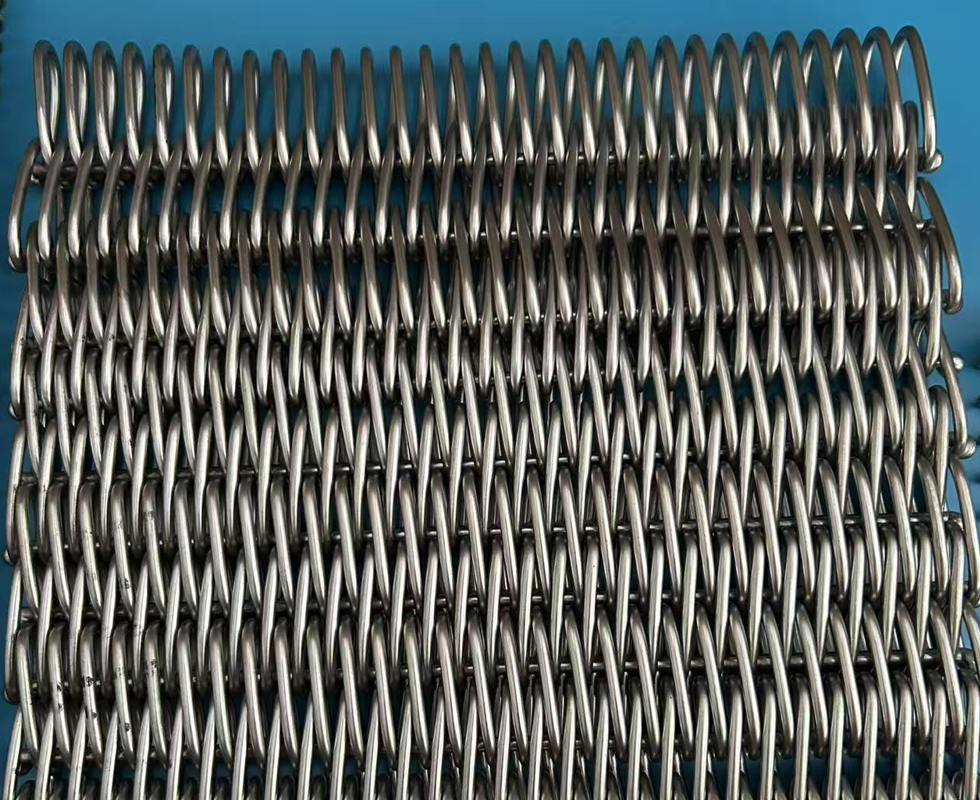
In the field of industrial production and conveying, stainless steel mesh belts serve as important conveying components widely used in various industries such as food processing, glass manufacturing, and heat treatment production lines. According to application requirements, the edge treatment methods of stainless steel mesh belts in the width direction mainly include two processes: sealed edge and raw edge.
These two treatment methods not only affect the appearance of the mesh belt but also directly relate to its safety, durability, and applicability. Understanding their differences is crucial for selecting the most suitable mesh belt product.
01 Overview of Stainless Steel Mesh Belts
Stainless steel mesh belts are mesh conveyor belts made of stainless steel materials such as 302, 304, 316, and 310S through weaving or welding.
They feature corrosion resistance, high temperature resistance, and high strength, capable of adapting to working environments at different temperatures, with a usable temperature range from -40°C to 1300°C.
Based on different weaving methods, stainless steel mesh belts can be classified into various types, such as herringbone mesh belts, Great Wall mesh belts (also known as horse hoof chains), Z-shaped mesh belts, balanced mesh belts, etc.
These mesh belts are widely used in automatic devices and automated production lines in industries such as petroleum, chemical, food processing, pharmaceutical, glass, and electronics.
02 Characteristics and Advantages of Sealed Edge Treatment
Sealed edge treatment refers to a process where the adjacent warp wires at both ends of the stainless steel mesh belt are connected together through special techniques, forming a complete and solid edge structure.
This treatment method makes the edge of the mesh belt smooth and flat, unlikely to have wire shedding.
The multiple advantages of sealed edge treatment are particularly prominent in industrial production:
High safety performance: Sealed edge treatment eliminates sharp burrs on the edge of the mesh belt, basically preventing hand pricking, greatly improving operator safety.
Sturdy and stable structure: The connection of adjacent warp wires makes the edge of the mesh belt more secure, less prone to deformation, able to maintain smooth operation, and reduce deviation.
Long service life: By preventing loosening and shedding of edge mesh wires, sealed edge treatment effectively extends the service life of the mesh belt and reduces replacement frequency and maintenance costs.
Strong wear resistance: The sturdy edge structure enables the mesh belt to withstand friction and load better, especially suitable for heavy-duty conveying scenarios.
03 Characteristics and Application Scenarios of Raw Edge Treatment
Raw edge treatment refers to the warp wires at the edge of the stainless steel mesh belt not undergoing special connection, maintaining the original state after cutting.
With this treatment method, two adjacent warp wires are not connected, prone to loosening and shedding.
Although raw edge mesh belts have lower safety, they still have application value in specific scenarios:
Lower cost: Due to omitting the edge sealing process, the processing time of raw edge mesh belts is shorter, and the production cost is significantly lower than that of sealed edge mesh belts.
Suitable for protective purposes: Raw edge mesh belts are usually used in non-precision conveying occasions such as mechanical operation protection.
Temporary applications: For some short-term or temporary production needs, raw edge mesh belts provide an economical and practical solution.
It is particularly important to note that when handling and installing raw edge stainless steel mesh belts, exposed metal wire ends can easily puncture palms. Operators must wear protective gloves and take safety measures.
04 Comparative Analysis: Sealed Edge vs. Raw Edge
There are significant differences between the two treatment methods in several aspects:
Structural solidity: Sealed edge mesh belts have a more robust structure because the edge warp wires are interconnected, making them less prone to deformation; whereas raw edge mesh belts lack reinforced edges and are prone to loosening.
Safety performance: Sealed edge treatment eliminates sharp edges, ensuring operational safety; raw edge mesh belts have sharp edges, posing safety hazards.
Processing cost: Sealed edge treatment requires additional processes and time, resulting in higher costs; raw edge treatment has simpler processing procedures and lower costs.
Service life: Due to their sturdy structure, sealed edge mesh belts have a significantly longer service life than raw edge mesh belts.
Applicable scenarios: Sealed edge mesh belts are suitable for industries with high safety requirements such as food and electronics; raw edge mesh belts are mostly used in non-precision fields like mechanical protection.
05 Selection Guide: Sealed Edge or Raw Edge?
In practical applications, how to choose the appropriate mesh belt edge treatment method based on specific needs?
Here are some practical selection suggestions:
Consider safety requirements: In situations involving direct contact with operators, or in industries such as food and pharmaceuticals, priority should be given to sealed edge mesh belts to ensure safety.
Evaluate usage frequency and lifespan requirements: For long-term, high-frequency production lines, although sealed edge mesh belts have higher initial investment, their longer service life may result in lower overall costs.
Analyze characteristics of conveyed materials: When conveying small, valuable items (such as electronic components, precision instruments), sealed edge mesh belts can effectively prevent product scratching or contamination caused by edge wire ends.
Weigh budget constraints: For temporary, low-frequency usage scenarios, or when the budget is indeed limited, raw edge mesh belts can be an economical choice, but safety protection measures must be implemented.
Consider environmental factors: In high-temperature, corrosive environments, sealed edge mesh belts usually perform more stably and can better resist harsh conditions.
When choosing stainless steel mesh belts, an experienced engineer once told me: "Although edge treatment is a small detail, it is a key link determining the service life of the mesh belt." Sealed edge mesh belts have higher upfront investment but are more reliable in long-term operation; raw edge mesh belts, although low-cost, may require more frequent replacement and maintenance.
By weighing the pros and cons of both according to your specific needs, budget, and safety requirements, you can make the wisest choice.
 Previous:Advantages and applications of stainless steel unidirectional mesh belts
 Products List
Next:How to Select the Right Material for High-Temperature Stainless Steel Mesh Belts
 Categories
 Knowledge